


Home > Dholera Smart City Investment: Step-by-Step Guide for Investors
Dholera Smart City Investment: Step-by-Step Guide for Investors
Published Apr 22, 2026
The best investment opportunities rarely announce themselves.
They don't come with headlines or excitement. They come with quiet signals, a new expressway here, a policy decision there, an industrial zone taking shape where there used to be nothing. Most people miss them. They miss them simply because early opportunities don't always look like opportunities yet. They feel uncertain. Premature. Easy to postpone.
And then one day, the uncertainty lifts. Prices move. Demand arrives. The window closes. The people who acted early are already ahead.
We've seen this before. Gurugram was farmland on the edge of Delhi before the IT companies came. Navi Mumbai felt inconvenient until it wasn't. Both rewarded early investors with returns that now look almost obvious, but only in hindsight. In the moment, they required conviction.
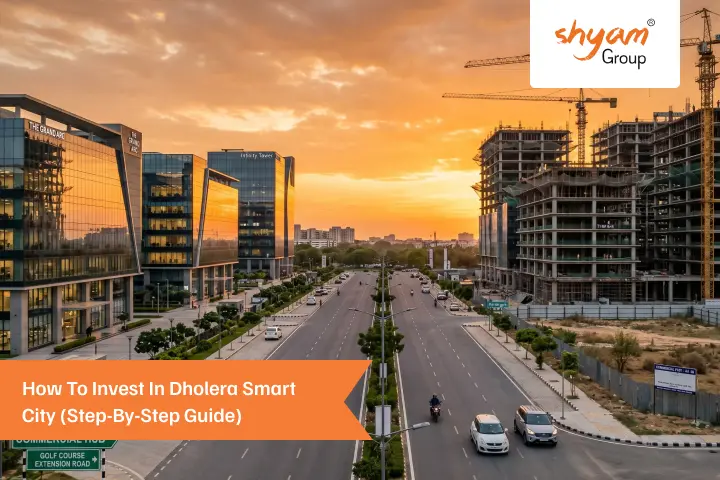
The groundwork isn't speculative; it's visible. Roads are being laid. Industrial zones are being defined. An international cargo airport is under construction. And yet land prices still reflect what the city is today, not what it's clearly going to be. That gap between present reality and future potential is exactly where the real dholera investment opportunity lives.
If you've been trying to figure out how to invest in Dholera and wondering whether you've already missed it, you haven't. But the window is narrowing. This guide will walk you through everything: where Dholera city actually is, why serious investors are taking it seriously, what you can invest in, and exactly how the process works from start to finish.
Where Is Dholera City?
Before evaluating any opportunity, you need to understand what you're actually looking at.
Dholera sits in the Ahmedabad district of Gujarat, roughly 100 kilometres south of Ahmedabad city, along the Gulf of Khambhat coastline. It's officially designated as the Dholera Special Investment Region (Dholera SIR), a greenfield urban and industrial zone covering approximately 920 square kilometres. That's nearly twice the size of Mumbai island, and every square kilometre of it is being planned from scratch.
This isn't an extension of an existing city. It's a new one, deliberately built, with residential zones, commercial districts, industrial corridors, and institutional precincts all mapped out in proportion from the beginning. The infrastructure goes in first. That matters more than it sounds. Most Indian cities grew organically, which means upgrading roads and utilities into spaces never designed to hold them. Dholera doesn't have that problem.
There's something else worth knowing. The ancient port city of Lothal, one of the Indus Valley Civilization's most sophisticated settlements, sat just 12 km from where Dholera is being built today; the city was designed around trade and commerce thousands of years ago, in almost the same location. What's happening now is technically different in every sense. But the underlying logic built where geography and opportunity align is the same.
How to Reach Dholera from Ahmedabad
The Ahmedabad–Dholera Expressway is already open. It's a six-lane road and gets you from Ahmedabad to Dholera in under an hour. No waiting, no plans, you can drive it today.
And connectivity is only going to get better from here. The Metro Rail is being extended from Ahmedabad toward Dholera under Phase 2. A new international cargo airport set to be the largest greenfield cargo airport in Asia is being built about 10 km from the main development area. And the historic Lothal Seaport, just 12 km away, is also being revived for maritime trade.
Right now, getting to Dholera is easy. In a few years, it'll be even easier.
Why Investors Are Taking Dholera SIR Seriously
The interest in Dholera Smart City investment isn't hype. It's structural. Four things specifically make this different from most emerging real estate stories.
First, the reason to consider Dholera is that it is India’s only Greenfield Smart City, implying that it is a city created in a barren land from scratch rather than developing it from an already congested one. It allows the creation of infrastructure right in the beginning without any hindrance.
Second, the reason is because of its location, which lies at the very center of the Delhi-Mumbai Industrial Corridor project, a 1,500-km industrial development corridor project that is being developed in collaboration with Japan, and is funded by both the central government and the Gujarat government.
Third, the infrastructure isn't a plan; it's in execution. The expressway is done. The airport is an active construction site. Metro connectivity is progressing. These are commitments that have been made, budgeted, and are being delivered.
Fourth, pricing hasn't caught up yet. Land in a fully activated smart city with metro access, an international airport, and a working population commands prices that are in an entirely different range from what's available in investment in Dholera Smart City today. That gap is the investor's window.
Investment Opportunities in Dholera Smart City
Investment in Dholera Smart City broadly falls into three categories. Each one suits a different type of investor, capital size, and time horizon. There's no universal best option, only the one that fits your specific goal.
1. Residential Plots Investment
That's where most retail investors begin their journey, quite rightly so. Residential plots give the easiest way into dholera investments, and it follows the usual sequence followed by India's planned city development history: land bought before population begins growing experiences maximum growth in value.
Why? The logic is pretty simple. Dholera's master plan envisions over two million people living there. Industries generate jobs, people move in, and housing requirements arise. Those lands acquired at an early stage benefit from both aspects.
Residential plots appeal to those investors looking to invest in something inexpensive and who can afford to hold on for 6-10 years, with the added advantage that it allows them to have multiple options – whether they want to sell, hold, or build later on. However, location matters in the case of residential lands, as well. Locations that are closer to metro links, expressways, and even future social amenities outperform lands in the periphery. And when considering a particular project, make sure you ask just one question: What happens in the five-kilometre radius of this land, and how soon?
2. Commercial Land Investment
Cities don't grow on housing alone. They need offices, retail, hospitality, and service infrastructure, and as Dholera's residential and industrial activity scales, demand for commercial space follows naturally.
The master plan allocates commercial zones near the Trade Center, expressway frontages, and airport approach areas precisely where footfall and business density will concentrate. Investors who secure land in those zones before the demand materializes are positioned for both appreciation and eventual rental yield.
Commercial land suits investors who can deploy slightly more capital, want exposure to business-driven growth, and are thinking about rental income over the medium to long term. It's also worth considering for business owners planning Gujarat operations who would rather own their commercial space than lease it.
3. Industrial Land Investment
This is where Dholera Investment genuinely stands apart from every other real estate market in India.
The entire rationale for creating Dholera SIR was industrial. The DMIC was built to make India a global manufacturing destination, and Dholera was positioned as one of its anchor nodes, not incidentally, but by design. Industrial land here isn't a secondary consideration. It's the spine the city was built around.
With Asia's largest greenfield cargo airport under construction 10 km away, the Lothal seaport being reactivated for maritime exports, plug-and-play utilities pre-commissioned within the SIR, and Gujarat's single-window clearance systems reducing bureaucratic friction, the conditions for manufacturing investment in Dholera Smart City are structurally excellent.
Industrial investment suits manufacturing and logistics companies planning Gujarat operations, high-net-worth investors seeking exposure to India's industrial growth story, and anyone with a 7–15 year horizon and the capital to match.
Learn more: Types of Investment Opportunities in Dholera City (2026)
How to Invest in Dholera Smart City: Step-by-Step Guide (2026)
Dholera investment is easier when you follow a structured approach. Let’s break down the exact step-by-step process investors are using today.
Step 1: Clarify your objective
What are you actually trying to achieve? Long-term appreciation? Rental income? Business expansion? Portfolio diversification? Your answer determines which category fits, what holding period makes sense, and which return profile to evaluate against. Get clear on this before you look at a single plot.
Step 2: Learn from the master plan
The master plan of Dholera SIR is publicly available online. You need to identify the zones that are residential, commercial, industrial, and green buffer zones. You must especially check for distance from expressway, metro line, the approach road to the airport, and the trade center. The infrastructure determines which zone will appreciate first.
Step 3: Conduct thorough research on your developer.
As a developing city, the developer is as important as the plot itself. All developers working in Dholera have different legal standings, different execution track records, and different post-execution support structures. Ask yourself these questions: Is your project RERA registered in GujRERA? Does the developer come with CRISIL verification? Have they delivered any projects, and what are their resale policies?
Here, experience counts for a lot. Shyam Group started developing plots in Dholera SIR as early as 2013, making them one of the pioneers of Dholera. With over 12 lakhs of Sq ft of land developed in Dholera, Shyam Group has executed and delivered multiple residential projects and introduced over 700+ investors from across 11 nations into Dholera.
Their projects are RERA-compliant, CRISIL-verified, and ISO-certified, and they're the only developer in Dholera SIR currently offering a structured resale assistance programme, which gives investors a real, practical exit mechanism rather than leaving them to figure it out alone.
That combination of early presence, delivery track record, and investor support isn't easy to find in an emerging city. It's worth factoring in seriously.
Step 4: Visit the site
Drive out. The expressway makes it easy. Walk the plot. Look at what surrounds it. No brochure tells you what ground-level observation does.
Step 5: Verify legal documents independently
Through your own property lawyer, not through documents the developer provides alone. Confirm clean land title, correct zone classification, RERA registration on GujRERA, applicable NOCs from DICDL, and applicable SIR regulations. A legitimate developer hands these over without hesitation. Reluctance to share is itself a signal.
Step 6: Evaluate pricing and payment structure
Compare across similar plots from multiple developers. Most credible developers offer structured installment plans. Ask what happens if delivery is delayed. Also run the proximity calculation, a plot 20% more expensive but 2 km closer to the metro corridor may deliver significantly better appreciation. That's a calculation worth making before signing.
Step 7: Execute and register properly
For residential plots: a registered Sale Agreement, followed by a registered Sale Deed on full payment. Registration with the sub-registrar is essential, not optional. For commercial and industrial land, the applicable structure may differ under SIR regulations; your legal counsel should guide this step.
Step 8: Hold strategically and plan your exit
Stay connected to Dholera's milestones. Airport commissioning, metro activation, and industrial anchor announcements are each one is a potential value inflection point. If your developer has a resale assistance programme, understand it early and use it proactively when the time comes. Shyam Group's resale assistance structure is specifically built for this, so investors aren't navigating the secondary market on their own.
Government Projects and Infrastructure
The real strength behind Dholera investment lies in the massive infrastructure being developed around it. Here’s the actual on-ground progress update as of 2026.*
| Infrastructure | Distance | Status |
|---|---|---|
| 6-Lane Ahmedabad–Dholera Expressway | Road-touch | Operational |
| Dholera International Airport | ~10 km | Under Construction |
| Metro Rail Phase 2 Extension | ~5 km | In Progress |
| Lothal Seaport Reactivation | ~12 km | In Progress |
| Dholera SIR Trade Center | ~6 km | Planned |
| DMIC Industrial Corridor | Through SIR | Active |
| Trunk Infrastructure (roads, power, water, ICT) | Within SIR | Phase-wise delivery |
Note: *Project status is indicative as of 2026 and subject to change based on government development timelines.
What this table shows is infrastructure in execution, not planning. The expressway is done. The airport, metro, and seaport are active construction sites with committed budgets. The institutional framework through DICDL provides administrative continuity that isn't tied to any single electoral cycle.
Gujarat's track record on delivery consistently ranked India's top state for ease of doing business, adding real credibility to these timelines in a way that not every state-led programme can claim.
Price Trends and ROI Potential
Prices for Dholera investment property have been going up year after year for the last ten years. Nonetheless, they are still based on the current situation of the city, not its future potential. This phenomenon is known as the development stage discount, or the difference between current prices and future ones.
Price ranges indicative as of mid-2026:
| Investment Type | Price Range (per sq. ft.)* | Key Variable |
|---|---|---|
| Residential Plots | Rs. 3,000 – Rs. 8,000 | Zone, layout, and infrastructure proximity |
| Commercial Land | Rs. 8,000 – Rs. 18,000 | Expressway frontage, Trade Center proximity |
| Industrial Land | Rs. 2,500 – Rs. 6,000 | SIR-designated parcel, plot size |
Note: *These are indicative ranges only. Actual pricing varies by plot size, developer, location, and payment terms. Always verify current rates directly with RERA-registered developers.
On returns: responsible projections for well-located Dholera residential plots over a 7–10 year horizon suggest annualized appreciation in the range of 15–25%, based on comparable Indian greenfield city development patterns. Commercial and industrial land in prime zones has historically outperformed residential in a city's activation phase, as business demand tends to be less price-sensitive than residential.
What must be said clearly: dholera investment is not a short-term play. If you need liquidity within two or three years, this isn't the right asset. The investors who come out ahead are those who buy at the right stage, choose location and developer carefully, and hold through the milestones.
Legal Checklist Before Investing in Dholera
| Sr. no | What to Check | Why It Matters |
|---|---|---|
| 1 | RERA Registration | Verify independently on GujRERA. Don't rely on developer confirmation alone. |
| 2 | CRISIL or Equivalent | No encumbrances, disputes, or court orders. Verify through your own lawyer. |
| 3 | Clear Land Title | No encumbrances, disputes, or court orders. Verify through your own lawyer. |
| 4 | Zone Classification | Master plan designation must match your intended use |
| 5 | Government Approvals and NOCs | DICDL, local authorities, and sector-specific regulators as applicable |
| 6 | Sale Agreement Registration | Ensure documents are stamped and registered. Unregistered documents offer minimal legal protection. |
| 7 | Developer Track Record | Completed and handed-over projects, not just launches or renders |
| 8 | Resale Policy | Understand the exit mechanism before you enter |
Conclusion
Final Thoughts on Dholera Smart City Investment:
Understanding how to invest in Dholera isn't complicated. The process is structured. The legal requirements are clear. The developers worth working with are identifiable through due diligence. What takes more than knowledge is timing, the willingness to move before the opportunity becomes obvious enough that pricing has already absorbed it.
Dholera isn't a finished city. That's the whole point.
The expressway runs. The airport is being built. The industrial corridor passes through it. Both the Central and Gujarat governments have committed real, auditable money to making this work. These aren't conditions that require speculation. They require evaluation and then a decision.
If you're ready to take that step, Shyam Group Dholerais worth your first conversation. They've been building in Dholera since 2013, long before it became a familiar name and have the track record, the certifications, and the investor support structure to back it up. CRISIL-verified projects, RERA-compliant layouts, and a resale assistance programme that no other Dholera developer currently offers. More than 700 investors across 11 countries have already made their decision. The city is being built. The infrastructure is being delivered. The question is simply whether you'll be positioned when it arrives.
.png)